March 16, 2011

RED AND BLUE TIDBITS by Ace Ligsay (Retrieved: February 6, 2011)

aSUNDAY, 6 FEBRUARY 2011



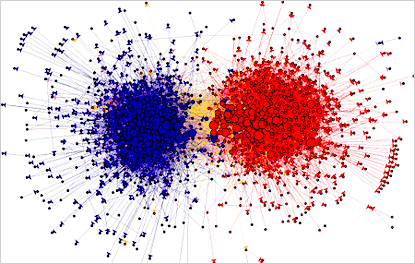
Election season is taking UP by storm. Hundreds of students package themselves in the best way possible and campaign from rooms to rooms, buildings to buildings. And I, as a part of the most exciting play annually staged in UP, feel the great divide among the three folds of the political spectrum-ALYANSA, STAND UP and KAISA. These political parties/social formations brand their leadership with strong and solid colors. ALYANSA banners a decent and passionate blue, and STAND UP chooses to be with the aggressive and color red. KAISA packages itself with a happy and burning yellow. 
This blog will focus on the comparison between the colors BLUE and RED (not the political party).
The researchers from Rochester and the University of Munich found out that color red has an effect on intellectual performance and it reveals that color associations are so strong and embedded so deeply that people are predisposed to certain reactions when they see red. Red is associated to red or failing marks in our high school test and research papers.
Elliot and his colleagues didn't use just any color of red. He assessed the colors using guidelines for hue, saturation, and brightness, and purchased a high-quality printer and a spectrophotometer for the research. He was stunned to learn that results from earlier work on color psychology by others didn't control for saturation and brightness.
The experiment banked on the hypothesis that color evokes motivation and has an effect without the subject knowing it. "It leads people to do worse without their knowledge," says Elliot. when it comes to academic achievement. The research shows that in one of the six tests given, for example, people were allowed a choice of questions to answer. Most of the participants decided to answer the easiest question, a classic example of how to avoid failure.
Studies by Andrew J. Elliot also found out that when people see even traces or spots of red red before being tested, they associate the color with mistakes and failures. In turn, they do poorly on the test. Red may be associated with the error marks within our high school test papers.
Another research spearheaded by scientists at the University of British Columbia studied more than 600 people as they performed various tasks, usually on a computer. Sometimes the screen's background color was red, sometimes it was blue.
These are the results of the experiment:


The experiments showed that with the red background, people did as much as 31 percent better at tasks like proofreading or solving anagrams, which require attention to detail. But for creative tasks, like designing a child's toy, a blue background improved performance.
New research shows that the color red makes us more cautious and attentive to details, while blue makes us more creative and receptive to new ideas.
The new research is exciting, but may be hard to apply to real-world decisions, says Nancy Stone at Missouri University of Science and Technology. For example, she says, it's not clear whether you should paint a library red or blue.


A blue environment might attract more people, she says, but a red one might help them focus.
In a nutshell, blue and red are strong colors. Advertisers and marketing practioners use blue and red to package their products. It gives an appeal to the human motivations and emotions. And as for this campaign season, the battle of blue and red continues. And as part of the blue team, I hope it’s true that blue attract more peopleJ.


University of Rochester (2007, March 1). Research On The Color Red Shows Definite Impact On Achievement. ScienceDaily

John Hamilton (2009, February 6). Study: Seeing Red, Blue Affects Outcome Of Tasks. NPR

March 8, 2011

ODE to the OTHER BOY By Ace de Guzman Ligsay


She rejected him thrice.  They shared moments of heaven then pushed him to hell.  It is a pocket book love story- juicy and complicated, with a tragic ending for the other boy.
It hurts to be the other boy.  Painful.  He feels an unpleasant sensory and emotional experience (as described by the International Association for the study of Pain).  And as suggested by the other boy- pain goes beyond the activation of receptors in the skin or tissue damage, or broken bones.


The other boy is experiencing pain in social situations.  And exploring his pain can be connected to a research made by experts from the University of California at Los Angeles.  These experts used MRI scanner to investigate and observe the brain as they manipulated the participant’s feelings.


To be able to illicit the emotion needed by the study, they made a simulation of a social scenario.  A computer generated game of ball throwing is conducted.  There were three participants to the game and one of them is the participant, the other two is computer controlled.  They made the participant believed that the other two participants were controlled by real persons.  As the game progressed, the computer controlled players started to throw the ball at each other excluding the participant. 


In social situations, exclusion often than not is emotionally painful.  The experiment traced the neural machinery of the pain felt by the participant in the anterior cingulate cortex and this are of the brain is also associated to physical pain perception.


Anterior cingulate cortex was also observed to be activated when you are empathizing to a person’s personal pain- putting your shoes to his/her shoes and sharing of the other’s personal pain.
Dr Jaak Panksepp, from the Centre for Neuroscience, Mind and Behavior at Bowling Green State University in Ohio, remarked that "Psychological pain in humans, especially grief and intense loneliness, may share some of the same neural pathways that elaborate physical pain.”  The statement suggested that emotional torture brought about by social rejection and denial or verbal abuse can be as painful as physical abuse.


The other boy is now afraid of rejection, or any withdrawal of social support from anyone.     The other boy sits alone and hums happy songs, trying to repress odd feelings.  

March 7, 2011

No pain no gain by Vhina Sison

Pain. Pain.Pain. How painful can things get? Sometimes Id wonder if pain is really real because there are situations wherein I know it isn't supposed to hurt me but I still feel the thing we call pain. Hmmm Im sure that there are a lot of effective ways in reducing one's feeling of pain. Hypnosis has been known to make people feel something else instead of another, even if they are not as "willful" to do so, thus the person then has an easier time "coping". Ok, so there's this interesting journal that captured my attention, because it explored Hypnosis as a mechanism to define pain perception. can pain be reduced through the aid of hypnosis? 

A study conducted by Hylands-White & Derbyshire (2007) aimed to find out how Hypnosis can play a role in perceiving pain. The first part of the study explored Hypnotic susceptibility, which has something to do with the ability to focus one's attention to a task while ignoring other stimuli. They hypothesized that those people who have this characteristic are able to reduce their feelings of pain with the aid of distractors, because they are more skilled to focus on a task at hand. Participants were first given questionnaires to determine those who are HH ( high in Hypnotic susceptibility). Participants where then subjected to the cold pressor wherein their hand is submerged while trying to see whether they observe the flip of a geometric figure the necker's cube, which served as a task ( "distractor" from pain due to the coldness of water) . After which participants reported the amount of pain they felt with the help sensory and affective pain scale by Gracely McGrath and Dubner (1978) 
In the second part of the experiments, the other participants were subjected into 2 conditions that labelled the state of the participant, one had the pre-recorded indication of being in a relaxation state while the second one had the indication of being under hypnosis. In both conditions, participants had to submerge their hand in the cold pressor after hearing the pre-recorded labeling of one's state ( relaxation and hypnosis) then was asked to report their pain perception using the scale. 
Results showed that those in the first part of the study reported high levels of pain perception compared to those in the second part. Also on a curious note, those who were    "labeled" as being in the hypnotized conditions had reduced feelings of pain compared to those in the relaxation label.  
Study 2 was all about labeling and expectations. Since they were labeled as being hypnotized, they expected some degree of vulnerability from the pain. This actually reduced how much pain they felt. 
This study can benefit doctors or other health care professionals. According to Dr. Babu, a huge factor that affects hypnotizability is age. That is, children (more specifically) who are 7- 15 years old are easily put in a hypnotic trance (2007). Since it is actually children who are more affected by pain, pediatricians can utilize study 2 in effects to reduce pain perceived by their young patients. The doctors can pretend to be hypnotizing the children, whether successful of not, then label them as being hypnotized. From the studies, the pain felt by the children will be reduced. This can also be used by physicians to adults but i think that it is still important that these adults either believe in hypnosis. 
Wow amazing right! Not only can this be useful in the Medicinal setting but perhaps in everyday experience of pain. Can this work well in other sources of feeling pain? Can hypnosis be the key to those bad days of getting hurt, heartaches, or feeling that intense pain because of having been put down, and criticized? who knows, maybe i should have someone hypnotize me :p HAHA! 

bibliography:
Hylands-White & Derbyshire (2007). Modifying pain perception: Is it better to be hypnotizable or feel that you are being hypnotized? British society of experimental and clinical hypnosis. 24 (4), 143-153.

Babu, H. (2007). Factors Influencing Hypnotizability. Retrieved from http://ezinearticles.com/?Factors-Influencing-Hypnotizability&id=529380 on March 6, 2011

S(he’s) Br(ok)en by Patrick Rabanal

    Pain is a part of life. Every one gets hurt every once in a while, may it be physical or emotional. Just like when a relationship ends, many people might say that the girl would be devastated and the boy would be fine or not get affected by it as much as the girl, thus the title. It may be the result of the society, these gender roles and expectations, or some biological reason. Having this in mind, can we also say that men can handle or stand physical pain more than women?

    In a study by Burns et al (2010), they cited many studies that confirm the idea that women do report greater pain intensity and show a lower pain tolerance, compared to men exposed to the same stimuli.  In the study they focused on one mechanism that could be responsible for this sex difference: Suppression, which as defined by our friends Merriam and Webster, is the conscious intentional exclusion from consciousness of a thought or feeling. Adopting a previous study’s model, they believed attempts to suppress unwanted thoughts like those including pain may ironically increase the awareness or salience of the subject being suppressed. If women do use this strategy more, this may pertly explain the sex difference.

    In the study they had their participants (N = 222; women: 55%) undergo a cold pressor, where half of the sample was randomly assigned to suppress pain-related thoughts and feelings about the task while the other half was not. The pressor temperature was maintained between 0 and 3°C. A visual analog scale (VAS) was used to assess pain intensity on the 13-point scales ranging from 0 = ‘‘None at all’’ to 13 = ‘‘Extreme.’’


    Their results showed that: first, men in the No Suppression condition reported lower pain than women in the same condition; second, men in Suppression condition reported greater pain then men in No Suppression condition, but equivalent pain to women in No Suppression condition. Differences between men and women on pain in No Suppression condition were suggested to be partly due to women’s report of greater spontaneous use of suppression during the cold pressor. In conclusion, women may be experiencing more pain due to their coping strategy specifically suppression.


     We know that women experience pains that men would never experience like having to go through giving birth and their monthly period. With the findings from previous studies, would a man feel less pain or tolerate the pain better than women, if by some bizarre incident that a man gives birth? I’ not saying hat they are not painful, but doesn’t it just make you wonder?


John W. Burns; Erin Elfant; Phillip J., Q. (2010). Suppression of pain-related thoughts and feelings during pain-induction: sex differences in delayed pain responses. Journal of Behavioral Medicine, 33(3), 200-208.

March 6, 2011

Le Pain, as Pointed Out by Alexander Leandro Dela Fuente

In the summer before I went to college, my mother took me traveling. I wandered around a foreign land, enthralled at the sights around me, when my gaze fell onto a nearby shop. The store window cheerfully announced that it was peddling pain.

I was very amused, to say the least; I even took a picture. Unfortunately, I cannot find that picture anymore.

I did find my picture of Linkin Park, however.
Imagine my joy, nearly four years later, when I realized I could tell that story in a blog article about pain! See, pain and pain are related; according to Cracked.com, eating pain can help relieve pain!

Pain is bread. Isn't French great?
The cited reference described a study performed by researchers from the University of Chicago on rats. A light bulb was lit under their (the rats, not the researchers) cages; while the ensuing heat would normally lead to the rats lifting their naked paws, this effect would be delayed by the presence of consumables - in this case, chocolate chips and saccharine water. The lead author, neurobiology professor Dr. Peggy Mason, supposedly said that "eating stimulated a system in the part of the brain that controls subconscious responses, which was known to blunt pain" (Mason et al.,2009); I'm sure she said it in more specific terms, but Google Scholar's been remarkably unfriendly to me in my search for the actual article.

French sign art, on the other hand, is easy to find.

This did turn up, however; I'm glad it did, insofar as Mason et al.'s work didn't seem to cover cross-species applicability. Sure, they said they "believe the same effects can be seen in humans," but I don't think that counts.

Let's have some proof, aye?

Anyway, the journal article described a similar process: a temperature change was applied to participants and differences in reaction to the pain were correlated to the ingestion of isoenergetic meals. In the abstract, the researchers concluded that fat-rich food significantly reduced the pain response to their stimuli; at some point - whether before or after, I do not know - they also concluded that their hard work was far too important to be posted for free on the internet, which should explain why I'm only citing the abstract.

(No, of course they didn't write that part in the abstract.)

I'll leave what all this implies to Ge's article; while hers is about smoking, her cited model presents a relationship which I believe could apply to food.

What she said.
I'd provide proof (read: better quotes) if only it didn't necessitate a paid subscription to a journal site; hopefully whatever I decide to write about next will be better supported by scientists with a more liberal view towards sharing their written work.

Music lovers dont feel PAIN!! -Erik Andrade Tongol

As we were talking about pain in class, i suddenly remembered the incident that dislocated my shoulder. The excruciating pain emanating from my shoulder to my whole body was an experience I would never want to go through again. Even when the doctors injected pain killers in my system, the pain was still so intense that I could not even move an inch. It was as if the pain killers had no effect on me. If pain killers had little or no effect on me, what will happen the next time I experience intense pain? :(


I came across a journal article by Knussen, MacDonald & Mitchell (2008) studying about the effects of music and art on pain perception. The researchers investigated the effects of preferred music, visual distraction, and silence on the perception of pain. They used a repeated measures design, where 80 participants underwent three trials for the cold pressor with the three conditions; preferred music, preferred painting, and the silence control. The participants were measured of their pain tolerance, pain intensity, perceived control, anxiety, and a listening music patterns questionnaire. Results showed that the preferred music significantly increased the pain tolerance and perceived control  and decreased anxiety over the painful stimulus. The visual distraction and control silence both did not show significant differences in the perception of pain as compared to the preferred music condition. Also, this strengthens the proposal on familiarity as important in therapeutic music listening for pain. The experiment showed that the familiarity with the lyrics of the song leads to a higher tolerance for pain. 


Music once again surprised me. Its wide range of benefits from making people happy to increasing the tolerance of pain are really impressive. The findings of this study can help a lot of people especially those who are in constant pain. Next time I hit the gym or run, I will bring my ipod and play my favorite Sugarfree songs. The increase in pain tolerance can greatly multiply the gains during my exercise routine. I would not hesitate anymore to always bring my handy ipod because you'll never know what will happen. 


Knussen, C., Mitchell, L., & MacDonald, R. (2008). An investigation of the effects of music and art on pain perception. Psychology of Aesthetics, Creativity, and the Arts, 2(3), 162-170.

March 5, 2011

What hurts the most... by Ge

I tried smoking once in my life and hated it so much I never tried again. I actually didn’t know how to smoke so I figure I was probably doing it wrong, but I never bothered trying to smoke the right way anymore after that. Partly for fear that I might eventually like it, partly because I would never have the guts to walk into a store and buy myself a pack of cigarettes (HAHA), partly because of the awareness of how smoking can affect my body, but mostly because I just couldn’t stand the stink of it.

I grew up thinking it was a wasteful and destructive activity and I wondered why people still even do it at all. Around 6 years ago, I was over at my friend’s house watching TV in her room when I suddenly heard the click of a lighter. I looked back and saw that she was smoking by the window. I was scandalized, but I didn’t want to seem shrewish so I let her finish her cigarette before I asked her why she did it. She told me it helped her deal with the pain of her parents’ separation. I didn’t get it. Did smoking help relieve pain? Well I guess it made sense. I mean, no wonder so many people smoke.

Fast forward 6 years later. I know now that cigarettes aren’t meant to be pain relievers, but over the years I’ve observed that people who are sad or heartbroken or in physical pain do tend to want to smoke more. I guess it helps in some way.

This week in class we learned about the perception of pain. It caught my attention because pain, in all its wretchedness, is fundamental in human life - whether we like it or not. It’s just something we have to deal with everyday. And as we learned in class, pain is actually an important part of keeping our health and safety in check.

Relating this to smoking, I came across an article that explored the effects of pain induction on smoking urge and behavior. Some studies show that smoking appears to decrease the intensity of pain, but other studies reveal that smoking can actually aggravate it. Although the covariance there is unclear, what this particular study focuses on is the motivation to smoke.

The researchers used a cold pressor to induce pain on the participants then asked them to report their urge to smoke as well as observed their actual smoking behavior. As it turns out, the situational pain increased participants’ urge to smoke and shortened the latency before their actual smoking behavior. This is paralleled by my friend who admitted that she was motivated to smoke because of the pain she was experiencing from her parents’ split.

As I’ve observed, people really do use smoking to cope with pain. But I think it’d be useful for all the pain smokers out there to know this: the study suggests a reciprocal relationship between smoking and pain.

As a means of coping with pain, people are motivated to smoke. This leads to more smoking, which could aggravate the pain, which causes the urge to smoke some more, and so on and so forth. The cycle goes on and on, leading to heightened dependence on tobacco and probably even more pain.

Moral of the story?
Find better ways to cope. Sublimation, perhaps? Join an art class, play a sport, watch a movie, go out with friends, etc. You’ll find that channeling your pain towards more constructive and healthy activities can make for better pain management as well as a more productive use of time. :)

Ditre, J. W., & Brandon, T. H. (2008). Pain as a motivatior of smoking: effects of pain induction on smoking urge and behavior. Journal of Abnormal Psychology. 117(2), 467-472.